RoS The Seven Swords of Wayland

"Morax, Solas, Orias, Albion, Elidor, Beleth, Flauros. On each of them,
words of high magic unspoken since they were made. Wayland knew the danger.
Oh yes, he knew. That's why he scattered them and for hundreds of years
they remained apart. Two of them were buried. Others lost in battle and
some so cunningly hidden that none had knowledge of them. The search took
many years, many lives."
Robin of Sherwood and the Hounds of Lucifer
Props history
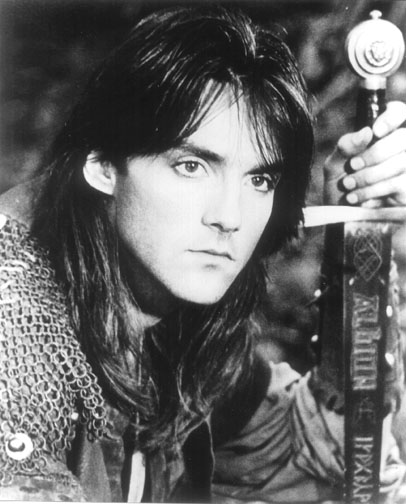
Albion is the only sword of Wayland that features in more RoS episodes than just
The Swords of Wayland, as it is Robin Hood's sword. It is entrusted to
Robin of Loxley by Herne the Hunter in the first episode, with the words: "It
is Albion. One of the Seven Swords of Wayland the Smith. Charged by him with
the powers of light and darkness." Before Robin dies, he gives Albion to
Marion, who guards it until she can pass it on to the next Robin Hood, Robert
of Huntingdon.
 |
Albion changed considerable between Season 1 (jeweled hilt, no name on the
blade, much more runes - where it went, is unknown) and 2 (plain hilt, "Albion" written on the blade, less
runes), because:
- The jeweled hilt was very bumpy and hurting the hands of Michael Praed and any stunt doubles who had to use it.
- When they decided to do The Swords of Wayland and had to show seven swords, it was decided that all the swords needed names on them.
Publicity pictures show Jason Connery with both the second series Albion and a
new Albion from the third series, which has the old hilt from Series 2 but a
new blade design.
Robin of Sherwood.net
has a page with detailed info about the various Albions.
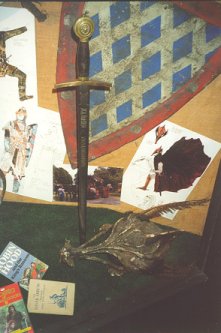
One of the Season 2 'fighting' Albions, used by Michael and Jason, was
on display in "The Tales of Robin Hood" museum in Nottingham, UK. According to
the plaque beside it, it was made by Alan Meekins and Tony Rotherham. The
"Tales", which closed down in January 2009 due to financial problems, also had
Herne's costume, a Hound of Lucifer mask and several other Robin of Sherwood
collectables (they weren't the property of the museum, though, just on loan).
Hopefully, they are all now at new
Robin hood:The outlaw returns
exhibition in
Galleries Of Justice Museum,
also in Notthingham.
|
There were multiple versions of Albion (fighting swords, close-up swords,
replacements throughout the series because swords broke or got lost etc.),
but the seven Swords of Wayland were one of a kind as they were for just a
one-off episode. They were specially commisioned pieces (presumably by Alan
Meekins and Tony Rotherham as well), acid etched, and cost £800 each even
back in 1984, according to Phil Rose.
Thanks to James Deval's diligent research (see
The Nothing's Forgotten Discussion Forum)
it has been determined that in The Swords of Wayland episodes the swords
have been wielded by:
- Albion: Robin of Loxley
- Orias: Lady Marion
- Morax: Will Scarlet
- Flauros: Little John
- Elidor: Nasir
- Solas: Friar Tuck
- Beleth: Much
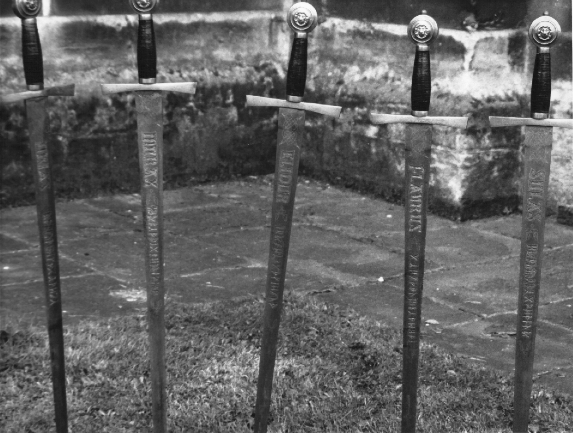
Phil Rose (Brother Tuck) was the keeper of the RoS Swords of Wayland for many
years, except for Beleth which had already disappeared during the filming.
Phil donated five Swords of Wayland to the charity auction at
Silver Arrow '98 convention.
Fact and figures
The Swords of Wayland feature a pommel with a lion's head on both side.
The runes run on just one side of the blade.
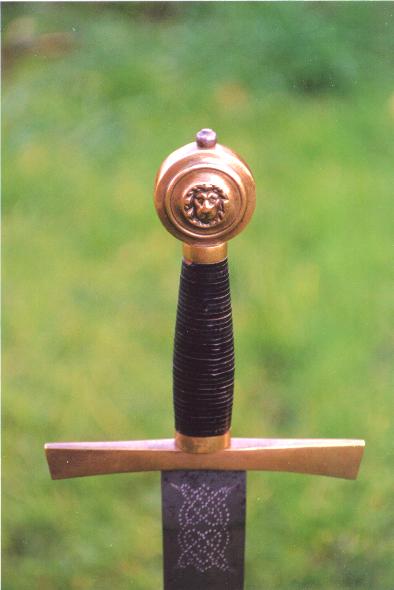 |
The following figures are based on Solas:
- Sword weight: 1.61 kg
- Pommel diameter: 2.24 inches / 5.7 cm
- Grip length: 4,92 inches / 12.5 cm
- Crossguard width: 7 inches / 18 cm
- Blade width: 2 inches / 5 cm (near crossguard) to 0.8 inches / 2 cm (near tip)
- Blade length (incl. ricasso): 31.5 inches / 79.5 cm
- Ricasso length: 1.38 inches / 3.5 cm
- Ricasso / riser thickness: 0.24 inches / 0.6 cm
- Edge thickness: 0.06 inches / 0.15 cm
For an explanation of the sword terminology, see the
Medieval Sword Glossary.
|
Replicas
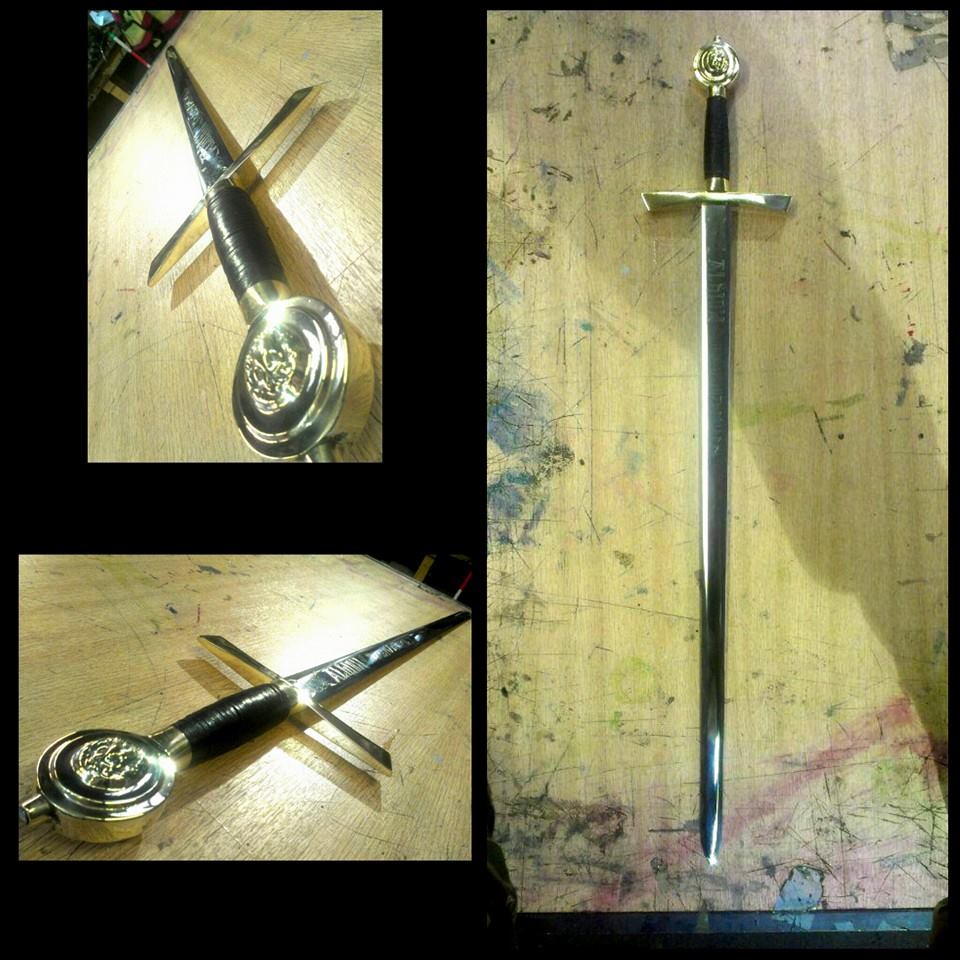
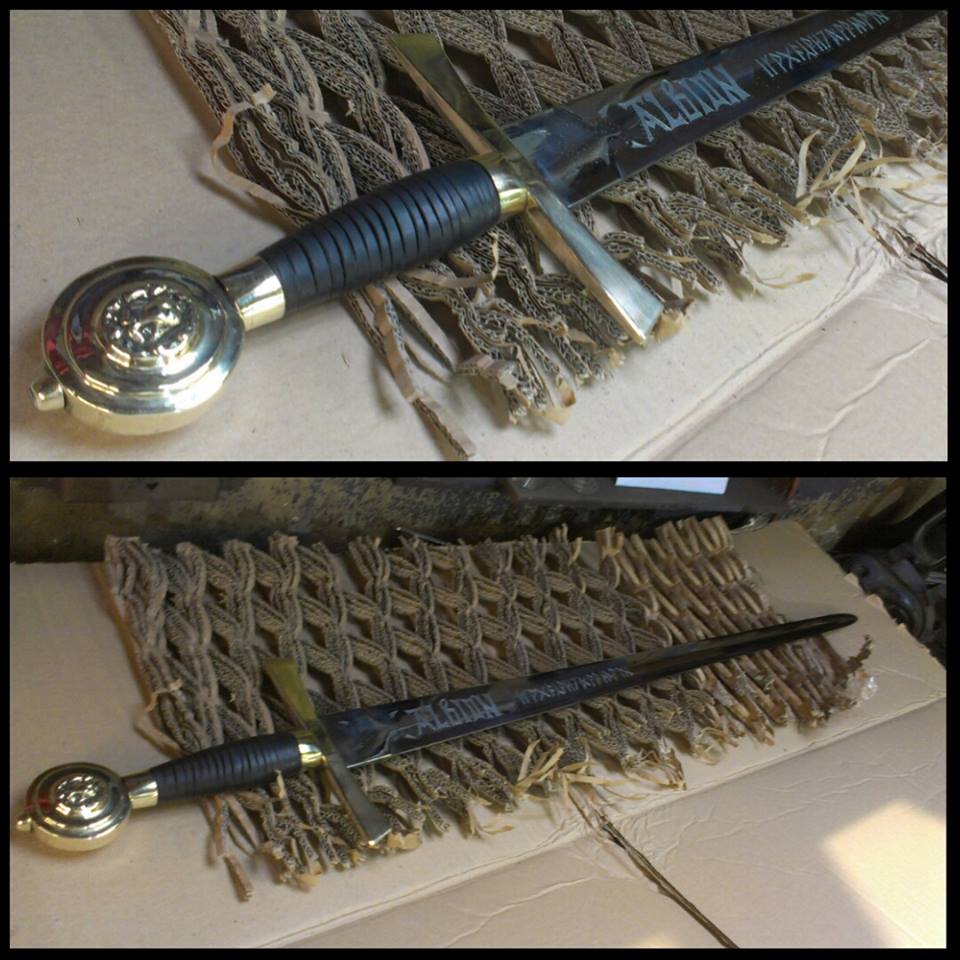
White Well Arms (UK)
Josef Daws of
White Well Arms
is making
Albion replicas
for GBP 350 and they take international orders.
The swords are loosely based off the original Albion sword which was displayed
in "The Tales of Robin Hood" in Nottingham, UK. The brass pommel is said to be
cast from the original.
Albion Swords / Film Swords (USA)
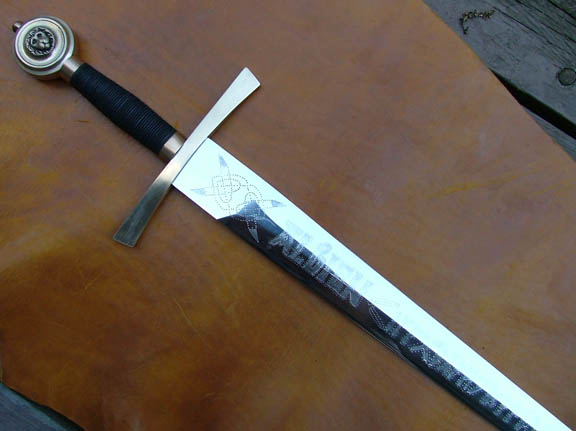
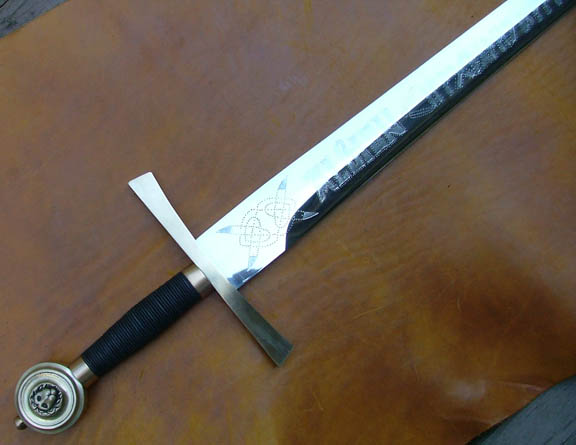
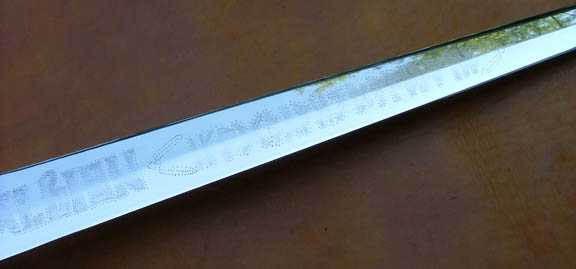
Lars Hansen of
Albion Swords /
Film Swords designed a
high-quality, sharpened Albion from the many versions of this sword. This
Special Limited Edition Albion Sword
costs U$ 1,320.
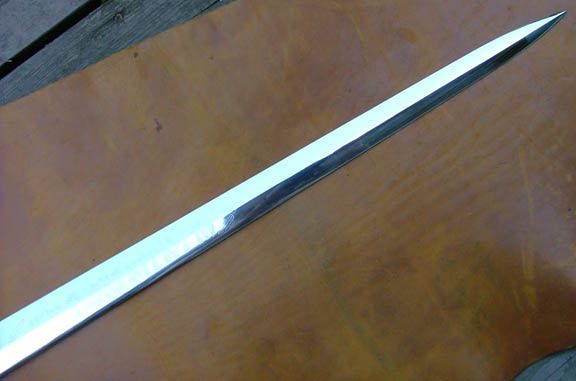
Heron Armoury (UK)
In 2000 armourer Tim Noyes of
Heron Armoury (UK) did a
custom-made battle-ready Albion replica on request from a couple of close-up
pictures and the Solas dimensions given above.
What's in a name?
Among other magical items that Wayland supposedly created, the Lemegeton or
Lesser Key of Solomon (Clavicula Salomonis, a grimoire attributed to King
Solomon but probably originating in medieval Italy) mentions the Seven Swords
of Wayland, each of which is imbued wih one of the seven powers of light and
darkness. Each of these powers is in turn connected to a certain demon or
entity. These entities and their corresponding power are:
Orias - Pauline Art (controlling of evil spirits)
Morax - Goetia (summoning of evil spirits)
Elidor or Eligor - Prophesy
Beleth - Beguilement (enchantment of individuals)
Flauros or Flowras - Hexing (cursing with illness)
Solas - Alchemy (creation of magical potions)
The seventh sword was not named, but unofficially has been called Abigor
(Albion in RoS) with the power of Scrying (divination). Abigor was conjured
for his power to foretell the future and to provide military aid and advice.
Nothing's Forgotten issue 10, page 12.
Jae Flemming has dedicated a whole webpage to this subject:
The Mystery of the Swords of Wayland ... Revealed .
In The Swords of Wayland Morgwyn of Ravenscar links a name of Lucifer
with each of the swords, picking up one of the swords when she speaks a name.
Unfortunately, in the TV episode you cannot see which name is associated with
which sword, but if you take the novelisation and align the order in which she
first names the swords and later she names Lucifer, then you get:
Elidor - Asmodeus, Creator of Judgement
Beleth - Satan the Adversary
Flaures - Behemoth the Beast
Morax - Diabolus the Devil, killing both body and soul
Solas - Demon, which signifies Cunning over Blood
Orias - Belial who is masterless
Albion - Beelzebub, Lord of the Flies
Runes
For those who want to know more about runes, here's a
webpage with rune links from around the world.
Albion
In the The Power of Albion it is suggested that the runes on Albion
mean: "Herne's son is my master. I cannot slay him."

The above drawing was made by Gary Rhodes from the 'fighting' Albion in "The
Tales of Robin Hood". It is unknown if it has different runes to the 'show'
Albion or not, or whether they are different from the Series 3 Albion.
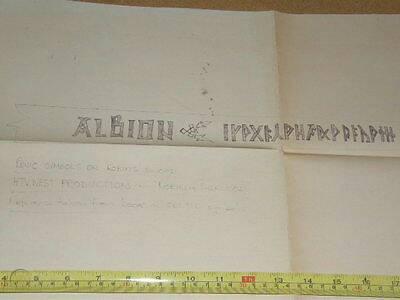
The above is listed on
WorthPoint
as a facsimile of a drawing originally made by RoS set designer John Biggs. Text
reads: "Runic symbols on Robin's sword. HTV West Production. Reference taken
from book on celtic symbols."
Morax

Solas

Hagalaz, the rune of transformation, banishment and intervention, begins
the talisman.
This is followed by the imcomplete form of Dagaz, the rune of complete
awakening. Dagaz is the epitome of life + death, body + soul.
The third rune is Wunjo: joy, delight, the harmonious existence of
affiliated sources. It binds the different fields of force together, aiming at
a specific result. The dot which follows it serves to emphasise the talismanic
phrase and gives it force at the point.
The next phrase (also ending with Wunjo) commences with Laguz.
This rune emphasises both phallic strength and the entry into the spiritual
realm through the watery passage of death.
There follows a bind rune based on Isa, the rune of ice. This bind rune
shows the sword's ability to stop or freeze his foe in his trackes.
This is followed by the esoteric form of Kenaz, the source of knowledge
and also the rune of controlled fire. This represents the sword wielder's
controlled emotion and wish for regeneration through possible death. Think
of the controlled power of the psyche which has led to the creation of the
sword!
Ansuz follows, the rune of incantation and of the protection of the
Goddess.
Here again stands Kenaz, neatly balanced now either side of Ansuz,
offering the sword wielder great strength. Ritually, Kenaz is the fire
of creation, and of the forge - a reminder of the sword's origin at the hands
of Weland!
Gebo is next, representing the gift of the gods to mankind. Gebo
also represents magical and esoteric power which is retained by the sword
wielder as knowledge of the underworld.
The last section of the talisman (following Wunjo) provides us with
Hagalaz once more, Wunjo and then 'K'. This latter rune is not
readily identifiable but could be construed as a modified version of the
Armanen form of Feun, the rune of fire and of the Goddess Freya. However,
I am unhappy with this since the Armanen system was not developed by List
until the 1900's!
The row ends with Laguz and then the incomplete Dagaz, the rune
of total awakening where body and soul, matter and energy are synthesised.
The whole talisman is weighted towards the idea of the magical focus of the
sword and its wielder. Looked at as a whole, we can see a progression
through the gift bestowed upon the wielder by the gods and goddesses to
enable the wielder to achieve as stasis and point of enlightenment. The double
use of Kenaz serves to emphasise this point.
This is very much a sword that is indebted both to Weland and to the forces
of the underworld.
Rune explanation curtesy of Mr. Kelvin Jones of
Oakmagic Publications.
Orias

Beleth
As Beleth has vanished long ago, unfortunately no pictures or runes of this
sword are available.
Flauros

Wayland
Wayland, also know as Weland, Weiland or Volund, features in Anglo-Saxon,
German and Scandinavian myths. He is sometimes known as the god of Smiths,
the German equivalent of Vulcan or Hephaestus, and at other times he is
portrayed as a Lord of the Elves.
|
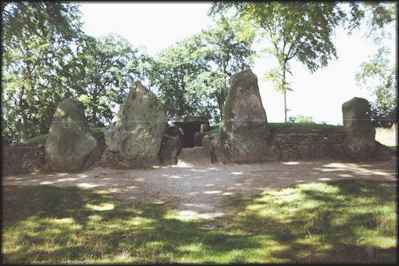
Traditionally, he is supposed to live at a Stone Age burial chamber
located
near the White Horse of Uffington in Oxfordshire, which has been known
as
Wayland's Smithy
since before the Norman Conquest. The legend says that
Wayland, smith of the Teutonic gods, was forced to shoe mortal's horses
for a living after the coming of Christianity. It was said that if a
traveller left his horse and a coin beside the smithy, when he returned
the horse would be shod and the coin gone. However, if the traveller did
not pay or attempted to watch then nothing would happen.
|
The myths
he features in tell how Wayland and his two brothers met three
swan maidens (or possibly Valkyries) by the shore of a lake and fell in
love with them. They stayed together for seven years until the swan maidens
flew off, and the three brothers went their separate ways to seek their
lost loves. Wayland was captured by the evil Swedish king Nmdud who
lamed him by cutting his hamstrings and forced him to work at his forge.
In revenge, Wayland killed two of the king's sons and turned their skulls
into drinking bowls, sending them to Nmdud as a gift. He also gave gifts
of jewellery made from their teeth to their sister, Bodvild. When she came
to Wayland with a ring to repair, he raped her, then revealed the nature
of his 'gifts' to the family. He escaped by creating a magical boat of
feathers to fly away in.
Wayland also had a famous sword called Balmung, and in a contest of skill
with Amilias he cleft him down to the thighs with the sword. Balmung was
so sharp that Amilias was not aware of the cut until he tried to move, then
fell apart into two pieces. The sword was later placed in a tree by Odin,
chief of the Norse gods, who stated that whoever could pull it out would
own it and be victorious in all battles. All ten of the German princes of
the time tried, and the youngest, Siegfried, succeeded. He featured
prominently in Norse mythology along with Balmung which he used to kill
Fafnir the dragon.
Nothing's Forgotten issue 10, page 12.
Seven Swords of Wayland game
This has nothing to do with RoS, but since it is about the seven swords of
Wayland, it is mentioned here anyway.
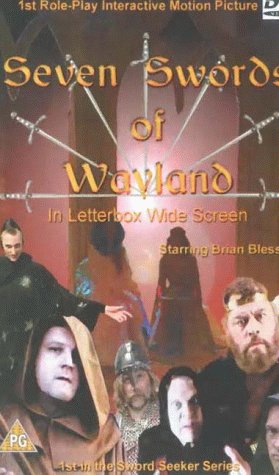
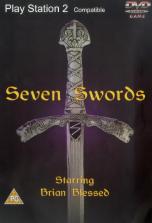
The Seven Swords of Wayland is an interactive motion picture which
follows the medieval adventures of Wizard Malakire, Lord Cedric as they search
for the Seven Swords of Wayland.
Stars : Brian Blessed, Jonathan Slack, James Rayment, Andre Lillis, John Rawls
Director : Mark Normandy
Release Date : November 22, 1999 / March 19, 2001
Manufacturer : Future Vision Productions Ltd
Catalogue Number : FVP0002 / FVP0002
ASIN : B00004D0FQ / B00005A3OJ
Barcode : 9781903163023
Aspect Ratio : 1.85 Wide Screen
Region Coding : Region 0, PAL
Run Time : 210 minutes approx
Certification : PG
Audio : Stereo
Language : English
Subtitles : None
Special Features: Trailer - 1. Original Trailer / Additional Footage - 1. Lute Music Demonstration / 2. Swordsmith Presentation / Outtakes / Additional Text - 1. Medieval Recipes / 2. Storyline Clues / Biographies
Last updated Tue 26 Jul 2022